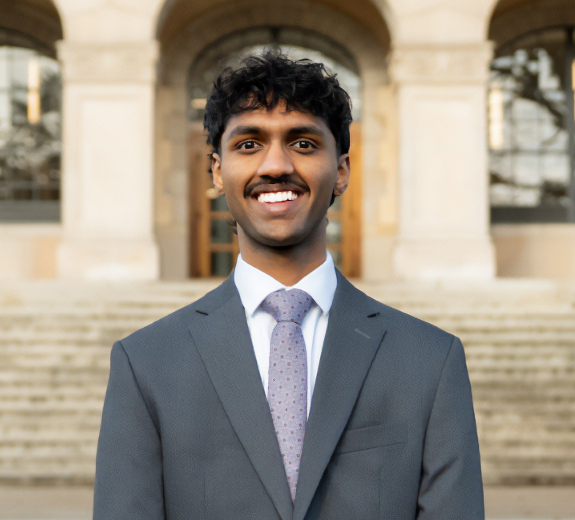
Shubham Bansal

“Keep Asking the Next Question:” Lessons Rhodes Scholar Shubham Bansal Learned at BRI

At age 15, Shubham Bansal was already thinking critically about his career. He didn’t know exactly what he wanted to do, but he was interested in research, biology and technology. Some Googling led him to the Linsley Lab at BRI, which uses advanced analytical tools to answer complex biomedical questions.

“The Linsley Lab appealed to me because it combines biology and technology,” Shubham said. “BRI’s mission and dedication to immune system disorders resonated with me, especially because my dad has an autoimmune disease.”

Shubham cold emailed Peter Linsley, PhD, to ask about volunteering in his lab. That was nearly four years ago, and he’s been working with Dr. Linsley ever since. Now a senior at the University of Washington (UW), Shubham recently earned one of the highest academic honors a student can get: a Rhodes Scholarship.

“I’ve met with Dr. Linsley almost every single week for the past few years. And those meetings have been a tremendous push toward getting me to where I am now,” Shubham said.

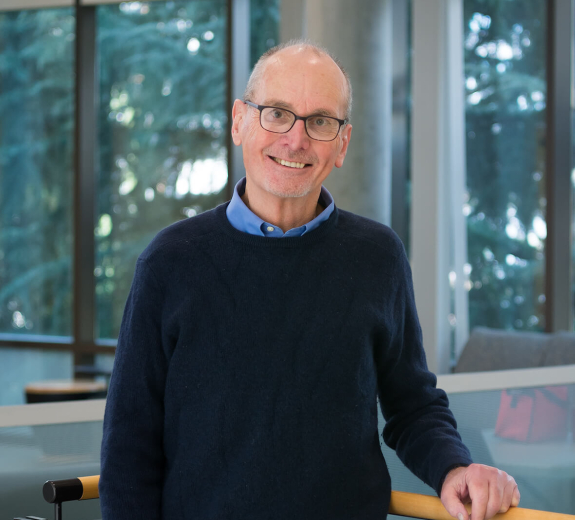
Peter Linsley
Peter Linsley, PhD

Joining the Linsley Lab

Dr. Linsley gets occasional emails from students interested in volunteering. But given that the minimum age for working in a lab is 18, he’s learned how important it is to distinguish younger students looking to build a resume from students who are motivated enough to work on data analysis remotely.

“I tell them to use online tutorials to learn the basics of the coding language R, and follow up when they’ve done that,” Dr. Linsley said. “At that point, many students disappear. But Shubham followed up a week or two later and said, ‘I’ve done that. What’s next?’”

Soon, Shubham was examining single-cell gene expression in the virus that causes COVID-19. Two years later, his name was alongside Dr. Linsley’s on a paper published in Nature Communications.

“My favorite thing is when I get to learn a new tool or technology, like using new machine learning algorithms to see if there are connections between two variables,” Shubham said.

When Shubham graduated high school at 16, he was eager to continue his work with Dr. Linsley. Shortly after starting at the UW, they met in person for the first time. Dr. Linsley needed to reschedule one of their meetings because he was in the hospital – and Shubham came to visit him.

“Here was this 17-year-old taking the time to visit an old guy like me in the hospital. We had never met face-to-face, but we just chatted away. It was great,” Dr. Linsley said.

Asking the next question

Shubham’s exploration of health and medicine hit a crossroads when he lost a loved one to a drug overdose. That experience was part of the impetus for starting Narcare, a nonprofit focused on preventing overdose deaths and challenging stigma surrounding addiction. He also chose to focus his studies on neuroscience and anthropology.

“One of the biggest lessons I’ve learned from Dr. Linsley is how to iterate and build on your results,” Shubham said. “Answering the research question is never the end of the story. That’s when you ask the next question to learn more. And you keep asking and keep iterating until you’ve found an answer that can help people.”

“Neuroscience teaches me about the biological aspects of the brain, how neural circuits and pathways influence behavior, especially in relation to addiction,” he said. “Anthropology shows me the behavioral aspect of why we act a certain way or which socioeconomic or cultural factors play into behavior, especially regarding health.”

While this lens is different from his research at BRI, the principles of scientific inquiry — examining what we know and designing experiments to ask new questions — are the same.

“One of the biggest lessons I’ve learned from Dr. Linsley is how to iterate and build on your results,” Shubham said. “Answering the research question is never the end of the story. That’s when you ask the next question to learn more. And you keep asking and keep iterating until you’ve found an answer that can help people.”

Charting a course

Shubham will never forget the day he was invited to present his research to other BRI scientists.

“I was terrified and super nervous, but I was so thankful afterwards that I didn’t chicken out,” he said.

After the presentation, he found the courage to talk to BRI President Jane Buckner, MD, and get her insight about doing research with an MD degree (versus a PhD or an MD/PhD). She told him an MD is a comprehensive degree that would allow him to pursue medicine and research — but just as important is being intentional about how he wants to use that degree and pursuing experiences that will help him get there.

That insight is one factor that helped Shubham set a long-term goal of pursuing an MD. But first, he’s headed to Oxford University to pursue a master’s in public policy with his Rhodes Scholarship.


“I know Shubham will make a significant contribution wherever he lands. My hope is that he lands in a career that makes him happy and fuels his passion,” Dr. Linsley said.

Making a lasting impact

Shubham’s choice to study public policy stems from a drive to make a broad and long-standing impact. In their weekly meetings, Dr. Linsley and Shubham have had many discussions about the various avenues Shubham could take to make the biggest impact. They also discuss topical issues like and cuts to NIH funding, and what the future state of science may look like.

“I know Shubham will make a significant contribution wherever he lands. My hope is that he lands in a career that makes him happy and fuels his passion,” Dr. Linsley said.

In the future, Shubham wants to bring what he learns in the clinic to inform legislation and policy.

“I’ve worked with community organizations, and they can make a huge difference, but we need more than volunteers and a patchwork of organizations. Lasting legislation will make the biggest difference,” Shubham said. “My hope is to see patients and understand how they’re impacted by various health disorders and use that understanding to make policy-level changes that really help people.”

Learn more about how early-career scientists make an impact at BRI: Read Lucy Li’s story.
 

Immuno-what? Hear the latest from BRI

Keep up to date on our latest research, new clinical trials and exciting publications.