


Innovation Fund Spotlight: Finding the Precise Moment When Immune Cells Start Causing Disease
Autoimmune diseases happen when immune cells, which are supposed to protect you from germs, mistakenly attack healthy tissues. But what if we knew exactly which immune cells would attack – and when? Could we stop that attack before it starts?
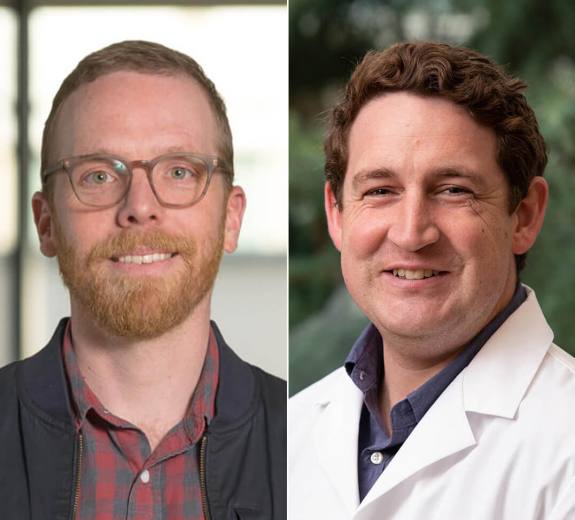
BRI’s John Ray, PhD, and Oliver Harrison, DPhil, are exploring exactly that. Thanks to an Innovation Fund grant, they’re using a tool called CRISPR-based lineage recording to pinpoint exactly when cells go from protecting you from germs, to attacking healthy tissues.
“Imagine you’re on a highway. You can’t just get off anywhere, you need to get off at an exit ramp,” Dr. Harrison said. “We want to find the exit ramp where cells leave the highway and turn toward disease. Because if we could do that, maybe we can find a way to keep them on course.”
Tell us more about CRISPR-based lineage recording. How does it work?
Dr. Ray: Lineage recording has been around for a while, and we are adapting it to study immune system cells. The particular type we’re using incorporates a gene-editing tool called CRISPR to record cellular histories. It was actually created to study how embryos develop.
It works by creating a small series of trackable changes in a cell’s DNA. As cells divide, they pass those changes on and accumulate new ones, creating genetic records of their history. We can later read that log of changes to reconstruct which cells came from where, and how they change over time.
Dr. Harrison: Historically, we’ve been able to take snapshots of where cells start and where they end, but it’s very difficult to know what happens in between. CRISPR-based lineage recording is changing that.
What types of questions will this tool help you answer?
Dr. Ray: I’m very interested in this idea of cell “tipping points” or the exact moment when a cell changes course to become pathogenic. This tool will help us track cells over the course of their development, zeroing in on disease-causing cells and what they looked like before they started causing disease.
Dr. Harrison: We’re using this tool in inflammatory bowel disease (IBD), which happens when your immune cells “lose tolerance” to harmless gut bacteria (i.e. they start attacking them).
Right now, we don’t know when or why they lose tolerance. We are using CRISPR-based lineage recording to look at a type of T cell called CD4 T cells to see if we can pinpoint that “tipping point” toward disease.
How might other BRI scientists use this tool?
Dr. Harrison: This tool is extremely adaptable and could be used by other scientists across BRI. About 90% of us study T cells, and this tool could be applied to other cell types, too.
Dr. Ray: I’m interested in using it in my work with Jessica Hamerman, PhD, studying lupus nephritis, a lupus-related kidney disease. In lupus nephritis, a group of cells called non-classical monocytes accumulate in and damage the kidneys. We suspect they come from another type of cell called classical monocytes. Everyone has both non-classical and classical monocytes in their blood, but we still don’t know when and where these non-classical monocytes decide to enter the kidney to cause disease. So, we’d like to better understand:
- Where is the tipping point when the cells turn toward disease?
- What makes certain cells turn toward disease?
- Can all non-classical monocytes turn toward disease?
- Is the decision made when they are still classical monocytes?
Down the line, how do you hope this work will help predict, prevent, reverse and cure immune system diseases?
Dr. Ray: Better understanding cellular tipping points is a gold mine, because if you can understand the exact places where cells decide to do one thing or another, it opens the door to influencing their behavior. If we find a way to stop cells from becoming pathogenic, it could create the opportunity to prevent disease.
Dr. Harrison: CRISPR-based lineage recording could also help inform more targeted therapies. Many current therapies knock out entire immune cell populations, which slows autoimmune disease but can leave a person vulnerable to infection. If instead, we could simply alter those cells so they don’t cause disease, that could potentially treat the disease with fewer side effects.
Why is philanthropy to support new tools and technologies important?
Dr. Ray: Part of advancing science is finding new, innovative ways to ask age-old questions. The Innovation Fund goes a long way in helping us do that. It also gives us the funding to prove that we can use these tools and collect preliminary data to apply for larger grants. This fund is already making a big impact: Many projects that started through this fund are now getting multi-million-dollar NIH grants.
Dr. Harrison: The Innovation Fund also allows us to explore approaches from different fields and apply them to our work. This tool was developed to study embryos; we’ve seen technologies in synthetic biology and neurobiology that we’re interested in. Having the funding to explore those technologies and see how we can use them at BRI can make a big impact.
A small investment makes a ripple effect because one tool can be used in so many ways at BRI. We’re deeply grateful for everyone who supports this fund.
Learn more
Read about other Innovation Fund projects:
- Pioneering a new generation of tetramers
- State-of-the-Art Genome Editing to Understand Disease and Develop New Therapies
Consider making a donation to support BRI’s Innovation Fund.
You Might Also Like
Innovation Fund Spotlight: Pioneering a New Generation of Tetramers
In the late 1990s, Bill Kwok, PhD, pioneered MHC class II tetramers, a game-changing tool in immunology research. Tetramers have fueled countless research breakthroughs because they enable scientists to find extremely rare cells and extract them to study in precise detail.
Fundamental Research is Paving the Way for New MS Treatments
BRI's Estelle Bettelli, PhD, is investigating whether targeting resident memory T cells could lead to new therapies for multiple sclerosis.
Game-Changing Treatment for T1D Enters Clinical Trials
A new T1D treatment, built on decades of research at BRI and other institutions, has entered human clinical trials.
Immuno-what? Hear the latest from BRI
Keep up to date on our latest research, new clinical trials and exciting publications.