Blog Nobel Peace Center Editorial

From Bootstrap Operation to Nobel Prize

How One Discovery Changed Our Understanding of the Immune System

It's 1995, and Steven Ziegler, PhD, is employee #4 at a biotech startup in Bothell. It's a bootstrap operation in a space that wasn’t built to be a lab. Some operations run out of renovated closets.

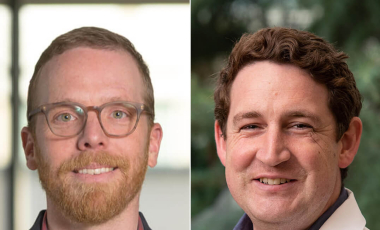
Steven F Ziegler
Steven F. Zielger, PhD

Dr. Ziegler hires two scientists – Fred Ramsdell, PhD, and Mary Brunkow, PhD. They start investigating why some mice develop fatal autoimmunity.

That work, started in a renovated closet in Bothell 30 years ago, won the 2025 Nobel Prize in Physiology or Medicine. It changed our fundamental understanding of the immune system and is the basis for much of BRI’s research today.

“At the time, we had no idea what we were looking at, beyond a genetic mutation that was catastrophic for the mice that had it,” Dr. Ziegler said. “If you told me then about the impact this work would have, I wouldn’t have believed it.”

Changing our understanding of the immune system

Drs. Ziegler, Ramsdell and Bronkow found the exact location of the mutated gene on the X chromosome before Dr. Ziegler left the startup and joined BRI. Then Drs. Ramsdell and Bronkow successfully cloned the gene (now called FOXP3) to study it further.

More critical findings came in the following years: Hans Ochs, MD, at Seattle Children’s identified a similar mutation in FOXP3 in IPEX syndrome, a rare syndrome that happens when the immune system spirals out of control.

Meanwhile in Japan, Shimon Sakaguchi, PhD, identified a molecule on the surface of certain T cells that could be used as a marker for “suppressor” T cells. This marker gave researchers a clear way to define regulatory T cells (Tregs) and separate them from other T cells. He later showed that in autoimmune disease models, Tregs could help prevent disease from starting. Together, these studies provided early evidence that a specific group of T cells can control and regulate immune responses.

Until then, scientists believed that immune tolerance — knowing to attack germs and leaving healthy tissue alone — was learned in the thymus, a small organ in the chest. The idea was that once the thymus trained immune cells early in life, they remained relatively fixed and unchanging.

Discovering FOXP3 revealed that while the thymus does educate immune cells, it's not the whole story. It taught scientists that tolerance is not static or permanent. Instead, Tregs can change the immune system throughout our lives.

“Learning that the immune system can be changed was revolutionary,” Dr. Ziegler said. “It opened the door to understanding exactly how Tregs work, and exploring if and how we can manipulate the immune system to fight disease.”


A new field of discovery

Dr. Ziegler and Jane Buckner, MD, (now BRI’s president) published their first paper on Treg biology in 2003. Ever since, they and many other BRI scientists have been exploring the role Tregs play in health and disease.

Scientists have built on these findings and made life-changing discoveries like checkpoint inhibitor therapy, which releases the brakes on the immune system to fight cancer. BRI scientists are pioneering an approach that does the opposite: It turns T cells into Tregs to curb the immune system attack in autoimmune disease.

Looking back, Dr. Ziegler sees this work as an example of what’s possible when NIH funding and private companies come together to back fundamental research. It’s not always clear where this research will go — but sometimes, it leads to life-changing discoveries.

Looking forward, Dr. Ziegler knows scientists will keep building on the work that started in 1995. He envisions a future where most cancers and autoimmune diseases are highly treatable; therapies will target the root cause of diseases with fewer side effects. He looks forward to toasting that reality with Dr. Ramsdell — with whom he still gets together for the occasional dinner or Mariners game.

“We’ll raise a glass of single malt whiskey and feel so fortunate to have been part of this,” Dr. Ziegler said.

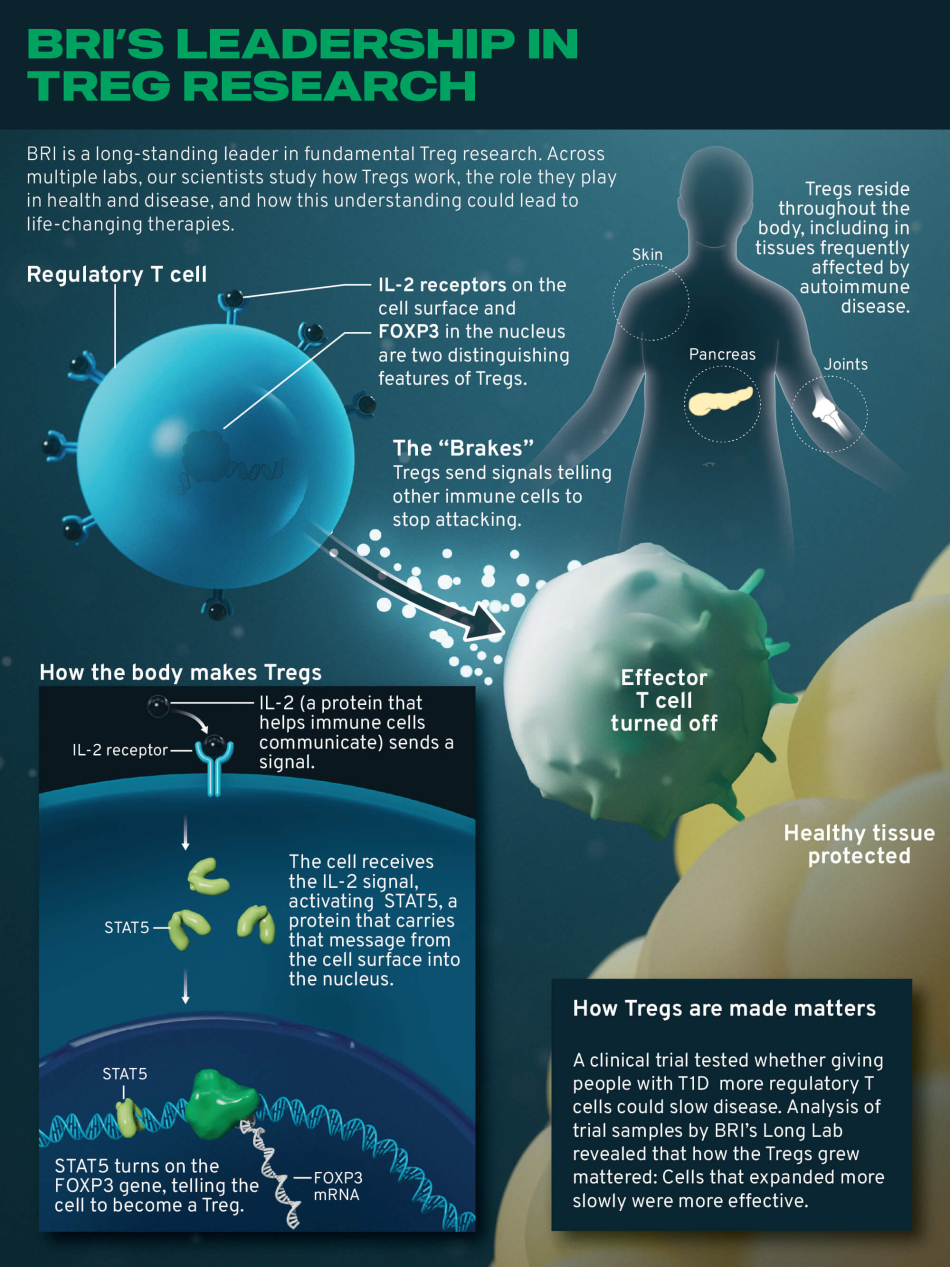
Graphic Inline 3D BRI Leadership In Treg Research Panel 1
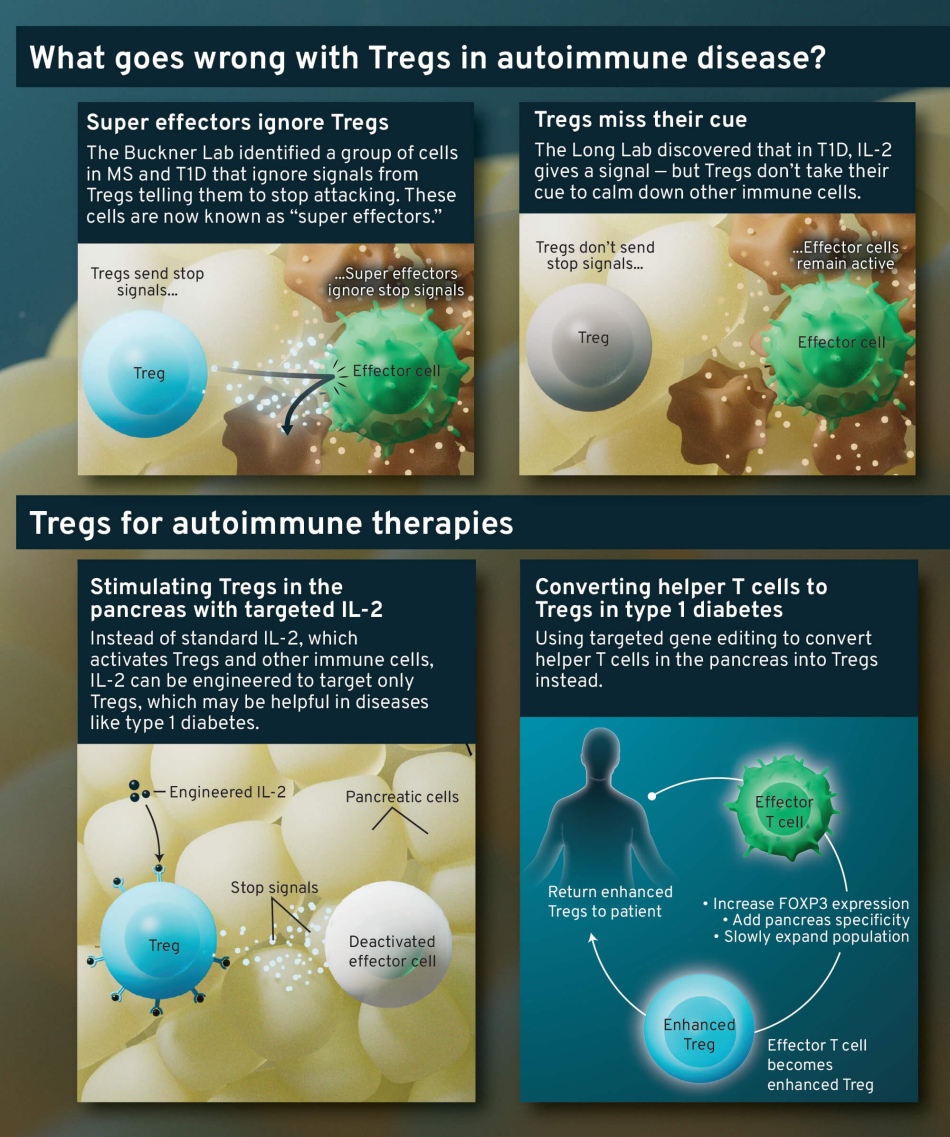
Graphic Inline 3D BRI Leadership In Treg Research Panel 2

Immuno-what? Hear the latest from BRI

Keep up to date on our latest research, new clinical trials and exciting publications.