Step 1: Understanding Tregs and IL-2
Dr. Campbell’s early work revealed that Tregs must be able to function in various tissues (the skin, the joints, the pancreas) to maintain balance in the immune system. Then his team detailed how Tregs use different strategies to fight different threats like viruses or bacteria.
They also dove deep into IL-2, exploring how it affects Tregs in different ways — and identifying precisely when IL-2 influences Tregs to push the immune system brakes.
“We needed to understand the basic functions of Tregs and IL-2, because we can’t fix the system unless we know how it works,” Dr. Campbell said. “Then we can ask: how can we use these systems to fight disease?”
Step 2: Using Your Own Cells to Fight Disease
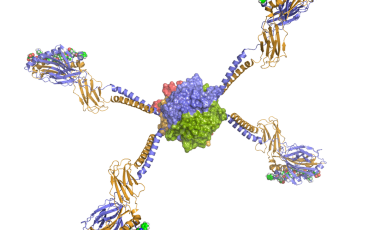
This understanding opened the door to a new treatment approach: engineering a version of IL-2 that only “talks” to very specific sets of Tregs — such as those in the pancreas of a person with type 1 diabetes.
Dr. Campbell’s team has pioneered this approach in models and is working with partners like the Immune Tolerance Network to study how this works in people. Now, his team is asking several important questions:
- What jobs do Tregs do in different tissues, and which Tregs have the biggest impact?
- When is the right time to administer an IL-2-based therapy? Could it be given before a patient has significant tissue damage and overt disease?
- Could this be a “one-and-done” treatment that resets the immune reactivity to self-tissues, rather than a therapy people need for the rest of their lives?
“These questions fascinate me, it’s like reading a mystery and seeing how it all fits together,” said Dr. Campbell. “What’s even more exciting is that trials of these types of therapies are starting. We’re seeing this go from concept to something that has significant potential to help people.”