

Faculty & Scientific Staff
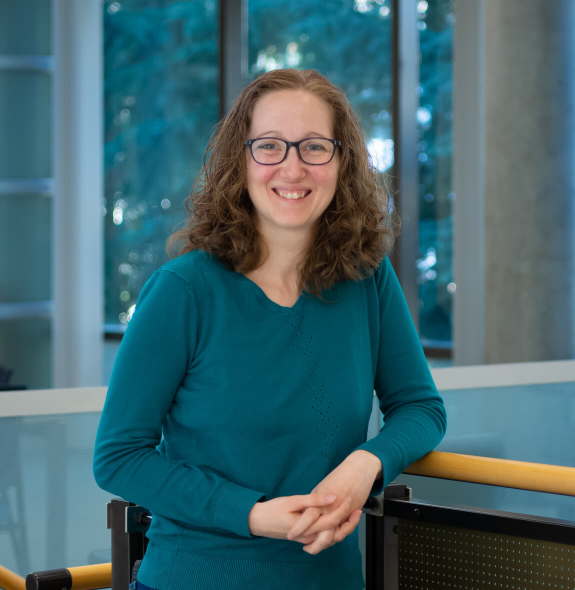
Caroline Stefani, PhD
Dr. Stefani earned a master's degree in cellular biology and immunology from the University of Nice Sophia Antipolis in France, graduating first in her class. She then completed her doctorate in the lab of Emmanuel Lemichez, PhD, at the Mediterranean Center of Molecular Medicine, where she studied how bacterial toxins alter the actin cytoskeleton. Her doctoral research received the Alexandre Joel Award from the French National Cancer Institute for work related to metastasis, as well as the University of Nice Sophia Antipolis Thesis of the Year Award.
After moving to the United States in 2013, Dr. Stefani joined BRI for postdoctoral training in the lab of Adam Lacy-Hulbert, PhD, and Lynda Stuart, MD, PhD. There, she used forward genetic screening to identify genes that protect cells from damage caused by bacterial toxins and pioneered the use of virtual reality for three-dimensional visualization of fluorescence microscopy images while helping develop automated image analysis pipelines.
Today, Dr. Stefani is a research assistant member at BRI, where she leads the Stefani Lab, manages the Imaging Core, and continues to collaborate with the Lacy-Hulbert Lab. Her research focuses on how cells detect and repair membrane damage and how these processes influence immune responses and disease. By integrating cell biology, immunology, and advanced imaging technologies, she aims to better understand tissue repair and immune system function.
Through her work with BRI’s Cell and Tissue Analysis Group, Dr. Stefani helps develop new imaging technologies and analytical approaches while advising researchers across the institute on experimental design, image acquisition, and quantitative image analysis. She also supports collaborators within and beyond BRI by advancing imaging capabilities that enable research into immune system function and disease.
Featured Publications
-
LITAF protects against pore-forming protein-induced cell death by promoting membrane repair.
Science ImmunologyStefani C, Bruchez AM, Rosasco MG, Yoshida AE, Fasano KJ, Levan PF, Lorant A, Hubbard NW, Oberst A, Stuart LM, Lacy-Hulbert A -
MicroMagnify: A Multiplexed Expansion Microscopy Method for Pathogens and Infected Tissues.
Advanced ScienceCheng Z, Stefani C, Skillman T, Klimas A, Lee A, DiBernardo EF, Brown KM, Milman T, Wang Y, Gallagher BR, Lagree K, Jena BP, Pulido JS, Filler SG, Mitchell AP, Hiller NL, Lacy-Hulbert A, Zhao Y -
T Cell Autocrine Hyaluronan Forms Complex Structures in CD4 T Cell Cytoplasm and Plays a Critical Role in Formation of the Immune Synapse
The Journal of Histochemistry and CytochemistryRobert B Vernon, Michel D Gooden, John A Gebe, Inkyung Kang, Caroline Stefani, Gail Workman, Adam Lacy-Hulbert, Paul L Bollyky, Thomas N Wight -
Integrin αvβ3 Limits Cytokine Production by Plasmacytoid Dendritic Cells and Restricts TLR-Driven Autoimmunity.
Journal of ImmunologyLorant AK, Yoshida AE, Gilbertson EA, Chu T, Stefani C, Acharya M, Hamerman JA, Lacy-Hulbert A -
Extracellular DNA traps in a ctenophore demonstrate immune cell behaviors in a non-bilaterian.
Nature CommunicationsVandepas LE, Stefani C, Domeier PP, Traylor-Knowles N, Goetz FW, Browne WE, Lacy-Hulbert A